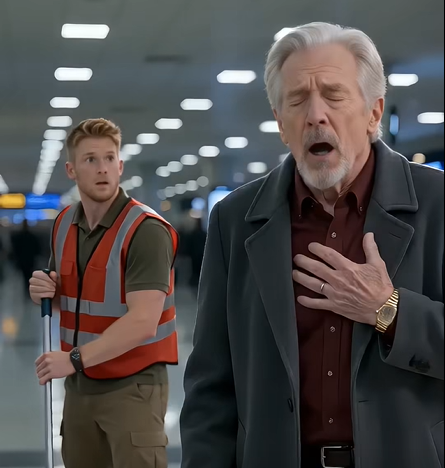
The elderly man ended the call and slipped the phone back into his coat as if nothing unusual had happened. The female manager stared at him, suddenly uneasy. “Who exactly are you?” she asked. He did not answer. Instead, he looked toward the cleaner disappearing down the terminal corridor and said quietly, “The only employee here who remembered that a human life matters more than a schedule.” Less than five minutes later, several executives in formal suits hurried through the terminal, followed by the airport’s operations director. The manager’s face drained of color when every one of them stopped in front of the old man. The director lowered his head respectfully. “Mr. Harrison, we came as soon as you called.”
The cleaner stopped walking when he heard the commotion behind him. He turned and watched from a distance as the same elderly man who had collapsed moments earlier slowly stood from the chair. His frail appearance seemed to disappear completely. One of the executives offered him support, but he waved the hand away. “I’m fine.” Then he looked directly at the manager. “I’m William Harrison, chairman of the company that operates this terminal.” The manager’s lips parted in shock. She immediately tried to smile. “Sir, I had no idea—” Harrison interrupted her. “That is exactly the problem. You should not need to know someone’s name or position before deciding whether they deserve help.”
The manager quickly tried to defend herself. “The cleaner abandoned his assigned area during working hours. I was only enforcing policy.” Harrison looked toward the security cameras mounted above the terminal. “Then let’s see exactly how you enforce policy.” He ordered the operations director to bring up the internal footage. Within minutes, a tablet showed the cleaner rushing to help him while the manager stood over them shouting. But the review did not stop there. Other clips appeared: the manager humiliating baggage workers in front of travelers, threatening employees for taking breaks, and berating an elderly janitor for moving too slowly. Several nearby workers lowered their eyes, clearly recognizing scenes they had been too afraid to report.
Harrison turned toward the employees gathered nearby. “How long has this been happening?” No one spoke at first. Then a young gate agent slowly raised her hand. “Almost a year, sir.” Another worker stepped forward. Then another. One by one, they described threats, unfair suspensions, unpaid overtime, and complaints that had mysteriously disappeared after being submitted. The manager’s confidence collapsed. “They’re exaggerating! They’re only saying this because they know you’re here!” Harrison remained calm. “Then an independent investigation will have no trouble proving you right.” He turned to the operations director. “Suspend her access immediately. Preserve every complaint, email, camera recording, and disciplinary report connected to her department.”
The manager looked around desperately as airport security approached. “You can’t do this because of one cleaner!” Harrison’s expression hardened. “This was never about one cleaner.” He pointed toward the chair where he had been sitting. “I came here tonight because employees had been reporting a culture of intimidation, and every report somehow vanished before reaching the board. I wanted to see this terminal without anyone knowing who I was.” He looked at her coldly. “You showed me exactly what I needed to see.” Her employee badge was removed, and she was escorted away from the terminal she had controlled through fear. For the first time, the workers watching did not lower their heads when she passed.
Harrison then called the cleaner back. The young man approached cautiously, still holding the few belongings he had collected after being fired. “Sir, I didn’t know who you were,” he said. Harrison smiled. “Good. That makes what you did worth more.” The cleaner shook his head. “Anyone would have helped you.” Several employees nearby exchanged uncomfortable looks. Harrison glanced around the terminal and replied, “Apparently not.” He restored the cleaner’s job immediately, ordered that he be compensated for the humiliation, and then surprised everyone by offering him a place in a new employee safety and welfare team. The cleaner looked stunned. “Why me?” Harrison answered, “Because procedures can be taught. Character is much harder to find.”
Weeks later, the terminal felt different. Employees could report mistreatment directly to an independent office, supervisors were retrained, and several managers connected to the missing complaints were removed. The cleaner remained on the night shift for a while, but now workers greeted him with respect whenever he passed with his cart. One evening, Harrison returned to the airport without an entourage. He found the cleaner helping an elderly traveler lift a heavy suitcase onto a luggage cart. When the cleaner finally noticed him, Harrison smiled. “Still getting distracted from work?” The young man laughed. “Only when someone needs help.” Harrison nodded and extended his hand. “Then don’t ever change.” The two shook hands beneath the bright terminal lights as travelers moved around them, and the place that had once punished compassion had finally learned to reward it.