
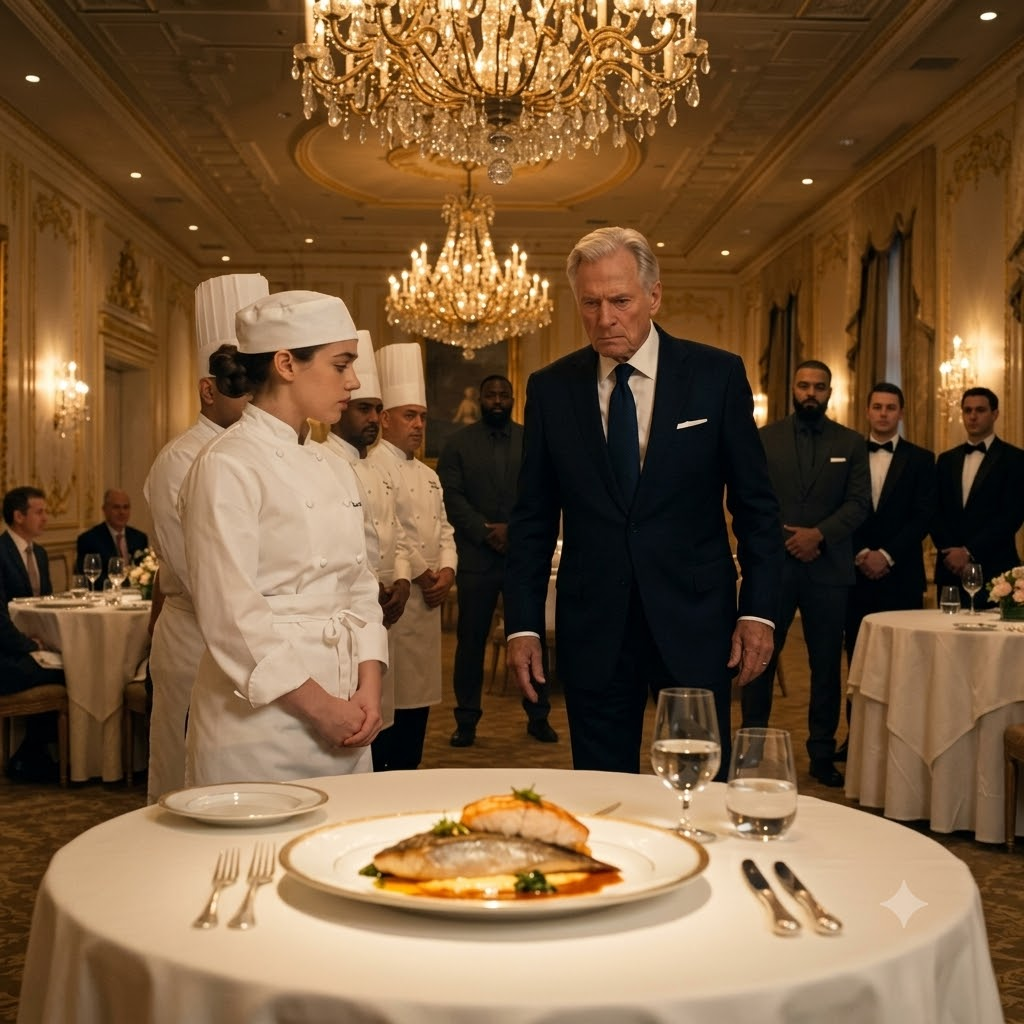
Charles stood frozen in front of Emily, unable to take his eyes off her. His voice, normally cold and controlled, trembled when he finally asked her mother’s name. Emily hesitated, confused by the powerful businessman’s sudden emotion, then quietly answered, “Margaret Carter.” Charles went pale. For several seconds, he could not speak. He stepped backward as if the name had physically struck him. Emily asked whether he had known her mother. Charles lowered his eyes toward the fish dish and admitted that he had known Margaret very well many years ago. Emily then revealed that her mother had died four years earlier after a long illness. Charles closed his eyes. The memory of the night Margaret walked out with a suitcase returned with painful clarity. He realized he had spent decades telling himself that she had simply disappeared from his life, when the truth was that his pride had allowed her to leave without ever trying hard enough to find her.
Emily explained that Margaret rarely talked about her past, but she had kept an old wooden box hidden in her bedroom for years. Before she died, she told Emily never to throw it away. Inside were photographs, a silver necklace, and several unopened letters that had never been mailed. Charles asked if he could see them. Later that night, after the restaurant closed, Emily reluctantly allowed him into her small Queens apartment. She placed the wooden box on the kitchen table and opened it. Charles immediately recognized a photograph of Margaret standing inside the modest apartment they had once shared. Behind her sat the same fish dish with the same distinctive sauce. His hands began shaking when Emily handed him a yellowed envelope. Written across the front in Margaret’s handwriting were the words “Charles Harrison.” The letter had never been opened.
Inside, Margaret wrote that she had discovered she was pregnant only weeks after leaving him. She had tried to contact Charles, but by then he had left New York to build his business overseas. She never wanted his money. She only wanted him to know that he was going to become a father. Another letter, written months later, explained that Margaret eventually stopped trying after seeing Charles’s growing success in newspapers and believing he had already chosen a new life. Charles stopped reading. His face lost all color. He looked at Emily, then back at the dates on the letters. Everything matched. Emily understood before he could say the words. “You think you’re my father?” she whispered. Charles stared at her with tears in his eyes, suddenly looking nothing like the untouchable businessman everyone feared.
A DNA test several days later confirmed the truth: Charles was Emily’s biological father. But the result did not magically turn them into a family. Emily was furious. She asked why he had never searched for Margaret after that terrible night, why he had allowed decades to pass without wondering what happened to her. Charles did not defend himself. He admitted that when he was young, he cared more about ambition than love. He had convinced himself that Margaret leaving was proof that she did not believe in him, when really he had pushed away the one person who had stood beside him before he had money or power. Emily told him that Margaret cooked that same fish dish every year on Emily’s birthday. She never explained why. Now Emily finally understood it was tied to the life her mother had once imagined they would share.
Charles began returning to the restaurant, but he stopped arriving with bodyguards surrounding him. He sat quietly at the same corner table, ordered simple meals, and watched Emily work without interfering. He never asked her to call him “Dad.” He never offered her a mansion or tried to buy forgiveness. Instead, he created a scholarship fund for young restaurant workers from difficult backgrounds and anonymously paid for culinary training programs across the city. Emily noticed the changes but remained cautious. One evening, Charles brought back every letter from Margaret, carefully protected in a leather folder. He told Emily that the letters belonged to her, not to him. “I’ve already taken enough from her life,” he said. Emily looked at him for a long moment and replied that she still did not know whether she could forgive him. Charles lowered his head. “I understand.”
Three months later, Emily invited Charles to her apartment for dinner. She prepared the fish dish exactly the way Margaret had taught her, using the same sauce that had shaken him in the restaurant. Charles sat silently as Emily placed the plate in front of him. She explained that growing up, she had always sensed there was someone missing from her mother’s stories. Margaret never spoke Charles’s name with hatred, but there was always sadness whenever Emily asked about her father. Emily admitted that part of her wanted to blame Charles for every difficult year they had endured. But another part of her knew she could not change the past. Charles told her he did not deserve an easy forgiveness. He only wanted the chance to become someone she could trust, even if it took the rest of his life.
Charles finally lifted his fork and tasted the fish. He closed his eyes. For one brief second, he saw Margaret standing in that tiny kitchen decades earlier, before the shouting, before the plates crashed to the floor, before the suitcase disappeared through the doorway. When he opened his eyes, Emily was still sitting across from him. This time, Charles did not raise his voice. He did not destroy the meal. He did not let someone he loved walk away. He gently set the fork down, wiped a tear from his cheek, and whispered, “It tastes exactly the same.” Emily lowered her eyes, fighting back tears, then gave him the smallest smile. Charles understood that the dish he had once knocked onto the floor in anger had somehow returned decades later to give him one final chance at the family he had thrown away.